
Key Takeaways
- Africa’s iGaming opportunity is significant, but success depends on understanding each market individually. Nigeria, Kenya, Ghana, and South Africa differ in player behavior, regulations, payment ecosystems, and competitive dynamics, requiring tailored market-entry strategies rather than a one-size-fits-all approach.
- Regulatory compliance and local payment integration are critical to successful expansion. Operators must navigate country-specific licensing frameworks while supporting preferred payment methods such as M-Pesa, MTN MoMo, OPay, Flutterwave, and local banking systems to deliver a seamless user experience.
- Mobile-first design and deep localization drive player acquisition and retention. High-performing platforms are optimized for low-bandwidth mobile devices, local currencies, regional sports preferences, and market-specific user experiences instead of simply translating content.
- Long-term success requires balancing scalability with market-specific customization. Operators that invest early in compliance, localized products, flexible technology, and adaptable platform architecture are best positioned to capture Africa’s rapidly growing online betting market.
iGaming in Africa is no longer a future story, it’s happening right now. According to PwC’s Africa Entertainment and Media Outlook 2025–2029, Nigeria, Kenya, and South Africa alone generated more than USD 600 million in gaming revenue in 2024. By 2028, Statista projects Africa’s online gambling market will reach USD 2.36 billion: a 6.28% CAGR driven by a young, mobile-native population with a deep-rooted passion for sports.
What makes this different from previous “next big market” narratives is infrastructure. Africa skipped desktop entirely and went straight to mobile. Over 90% of internet access on the continent is via mobile device, and mobile money ecosystems like M-Pesa have built payment rails that Western markets are still trying to replicate.
For any operator developing a sports betting software on this continent, that changes everything: from product design, payment architecture, and go-to-market approach included.


Market Overview: Nigeria, Kenya, Ghana & South Africa
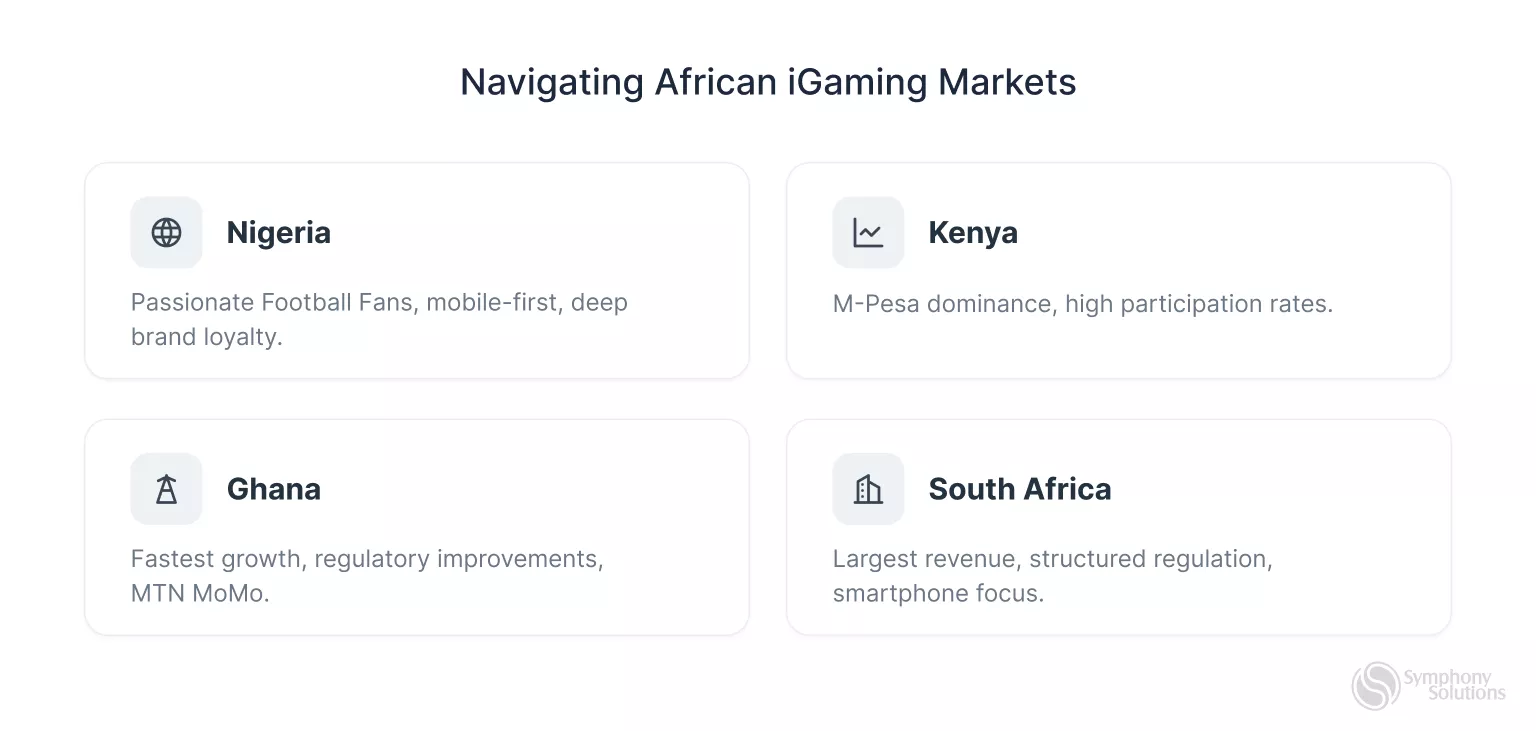
Africa isn’t one market. Each country has its own player behavior, payment habits, regulations, and competitive landscape. Understanding those differences is what separates operators that gain traction from those that struggle to grow. Here’s what you need to know about the continent’s four biggest iGaming markets.
Nigeria: Big, Fast, Football-Obsessed
With 220 million people, more than 60% under 25, and an estimated 60 million bettors active daily, the Nigeria betting market is the continent’s most dynamic. Industry estimates put Nigeria’s total betting economy at around ₦5.6 trillion (USD 3.3–3.6 billion) in 2025/26.
Brands like Bet9ja and SportyBet have built massive audiences through Premier League sponsorships and localized UX, and new entrants need to understand that brand loyalty runs deep here.
Nigeria runs on football, and football runs on mobile. Fintech wallets like OPay and Flutterwave handle most of the payment infrastructure, alongside USSD banking for feature phone users.
Kenya: Mobile Money Has Already Won
Kenya is a mature market. 83.90% of Kenyan adults have engaged in some form of betting according to GeoPoll, one of the highest participation rates in the world. The defining feature is M-Pesa: 90% of online bets in Kenya go through it. For operators, that is a single payment integration that unlocks essentially the entire market.
Ghana: The Market Moving Fastest Right Now
Ghana is where the action is in 2026. Ghana’s online gambling sector grew 24% in 2025, and international operators including Kaizen Gaming (Betano) are already entering.
The regulatory picture just got meaningfully better: Ghana abolished its 10% withholding tax on betting winnings in April 2025, removing a significant cost for operators and players alike. MTN MoMo covers both urban and rural areas. The sports betting in Africa thesis is playing out in real time in Accra, and the window to establish early brand presence is still open.
South Africa: The Largest, Most Structured Market
South Africa is the revenue heavyweight. Gross gambling revenue hit ZAR 59.3 billion (approximately USD 3.2 billion) in the 2023/24 financial year, with sports betting accounting for around 60.5% of total gambling revenue and 81% of betting turnover coming through smartphones and tablets.
The trade-off for scale is complexity. South Africa sportsbook regulation runs through a dual national/provincial structure, nine provincial boards, not one central authority. Online sports betting is legal; online casino gaming is not, a nuance that catches many international operators off guard.
Regulatory and Licensing Considerations
Regulation is one of the biggest differences between these markets. Each country has its own licensing model, tax rules, and compliance requirements, so a strategy that works in Kenya won’t automatically work in Nigeria, Ghana, or South Africa. Operators that want to succeed need a sportsbook compliance checklist before they enter the market, not after issues appear.
- Nigeria — NLRC / State Authorities: Following a 2024 Supreme Court ruling, licensing is now a hybrid of federal (NLRC) and state-level control. A Universal Reciprocity Certificate (URC) is being introduced for multi-state operations. Tax rates range from 4.5–15% by state.
- Kenya — BCLB: The Betting Control and Licensing Board is one of Africa’s most functional licensing environments. The 20% excise on stakes (not GGR) is the key financial consideration operators must model before entering.
- Ghana — Gaming Commission of Ghana: Governed by the Gaming Act 2006 (Act 721). A local shareholder must hold at least 10% of share capital. No dedicated gambling tax on GGR as of April 2025. AML requirements are tightening ahead of Ghana’s 2026 Mutual Evaluation.
- South Africa — NGB / Provincial Regulators: Nine provincial boards control licensing, with Western Cape and Mpumalanga leading for online operations. A 20% GGR tax on online betting is proposed but not yet enacted. Online casino gaming remains nationally prohibited.
Across all four markets, KYC, AML, and responsible gaming tools (self-exclusion, deposit limits, behavioural monitoring) are increasingly enforced, not just recommended. Build these into your platform architecture from day one.


Technology, Payments, and Localization Strategy
Technology is where market strategy becomes real. In Africa, operators cannot treat mobile design, local payments, and localization as separate decisions. They all shape whether users can find the platform, place a bet, fund an account, and keep coming back.
Mobile-First Is Not a Feature — It’s the Product
There is no desktop user base to design for. Portrait-mode UI, a four-click maximum to place a bet, and pages loading within 3 MB for 2G/3G connections are baseline requirements. Almost 1 billion Africans are not yet online despite network coverage existing. Operators who build content for low-bandwidth and older devices reach users competitors don’t.
Payment Integration: This Is Where Operators Win or Lose
No single integration covers all four markets. Know your stack before you launch.
| Market | Primary Method | Notes |
| Kenya | M-Pesa | 90% of bets. Use DPO or Cellulant to skip the direct Safaricom contract. |
| Nigeria | OPay, Flutterwave, Paystack | Plus USSD for feature phone users. |
| Ghana | MTN MoMo | Agents convert cash to digital credit across rural and urban areas. |
| South Africa | Cards + instant EFT | Most conventional payment environment on the continent. |
Do not overlook cash-in/cash-out agent networks. A meaningful share of users in all four markets are unbanked and access platforms through physical agents.
Localization Is More Than Translation
A gaming solution that feels imported will underperform one that feels local. In Nigeria, that means Premier League and AFCON markets front and centre, familiar bonus mechanics, and local team references. In South Africa, ZAR accounts and cricket/rugby markets alongside football.
That is why conversational UI for sportsbooks consistently outperforms conventional interfaces across all four markets. Users already know how to use it.
Key Challenges Operators Must Prepare For
Here are the key challenges to plan for before launch.
- Regulation moves fast. Nigeria overhauled licensing in 2024, South Africa still has no national online gambling law, and Ghana is mid-review. What’s compliant today may not be tomorrow, get local legal counsel in each market.
- Payments are fragmented. M-Pesa dominates Kenya but means nothing in Nigeria. There’s no single rail that covers all four markets, so build redundancy in from the start and don’t treat fraud monitoring as an afterthought.
- Existing operators have a strong foothold. Bet9ja and Hollywoodbets have sponsorships, agent networks, and brand loyalty you can’t buy your way past. Speed and product focus are your edge. Decide whether to build-or-buy a sportsbook to move quickly.
- Localization and scalability pull in opposite directions. Each market needs its own payment methods, sports markets, and UX patterns. Operators who copy-paste one platform across all four consistently lose to those who don’t. The BetSymphony sportsbook platform is built around solving exactly this.
Conclusion: Africa as a Long-Term Growth Opportunity
The operators winning sports betting in Africa right now are not the biggest-budget ones. They are the ones who took compliance seriously before launch, built for mobile first, and marketed through community rather than broadcast. The sports betting in Africa opportunity is real, it just rewards operators who treat these markets with genuine respect.
A continent of young, mobile-native, sports-obsessed users is entering its prime betting demographic. The question is not whether this market will grow — it is whether your operation will be inside it when it does.
If you are ready to move, the BetSymphony sportsbook platform and turnkey online casino platform are built for exactly these conditions.


FAQ
Nigeria, Kenya, Ghana, and South Africa are the leading markets. The right choice depends on your licensing strategy, budget, and target audience.
Yes, sports betting is legal in all four countries under their respective licensing frameworks. However, regulations differ significantly, and South Africa does not permit online casino gaming.
Operators should support local payment preferences, including mobile money in Kenya and Ghana, fintech wallets in Nigeria, and cards and EFT in South Africa. Cash agent networks also remain important.
Build for mobile first, support local payment methods, use local currencies, and prioritize the sports and user experience that players in each market expect.
The main challenges are navigating different regulations, integrating local payment systems, competing with established brands, and delivering a localized experience across multiple markets.