
Key takeaways
- Voice is becoming a mainstream digital interface: US voice-assistant use is forecast to rise from 142 million people in 2022 to 157.1 million by the end of 2026.
- Sportsbook voice requires more than speech-to-text. It must interpret betting slang, identify the intended event and market, check live odds, and ask for confirmation when a request is incomplete.
- Accent handling needs proper testing. One peer-reviewed ASR study found average word error rates of 35% for Black speakers and 19% for white speakers in its test corpus, evidence that generic accuracy claims are not enough.
- BetHarmony combines speech recognition, natural language understanding, conversation context, and live platform integration to guide players from a spoken request to a clear betting action.
- For operators, voice should be treated as a platform capability. The important measures are task completion, correct event and market mapping, confirmation handling, and reliable fallback to touch, text, or human support.
Voice assistants are becoming a familiar way to navigate digital services. Once used mainly for simple questions, timers, and music, they now support tasks across customer service, retail, banking, travel, and even sports betting. This expanding role is driving wider adoption: in the US alone, voice-assistant use is forecast to grow from 142 million people in 2022 to 157.1 million by the end of 2026.
But sports betting brings a different level of complexity. An AI voice betting assistant must do more than recognise spoken words; it must understand the request accurately before it can guide a player towards the right betting action.
That is especially true in live betting, where players rarely speak in carefully structured commands. They might say, “Give me BTTS on the Arsenal match,” then add, “Make it over 2.5 as well.” They may use betting slang, club nicknames, switch languages, shorten market names, or speak over background noise. A useful voice interface needs to understand all this and ask for clarification when needed.
BetHarmony, a conversational AI layer for sportsbook and casino platforms, is designed exactly for that. It supports chat, voice, market discovery, account queries, and guided bet placement through platform integrations.


Why Voice Recognition for Sports Betting Takes More Than Transcription
Automatic speech recognition (ASR) turns spoken audio into text. In a sportsbook, that is only the first step. A request can be transcribed perfectly and still be incomplete: the system must identify the event, market, stake, currency, and intended action, then check that the market is open and the odds are current.
That requires natural language understanding (NLU). IBM defines NLU as technology that identifies intent, meaning, and context, not just individual words. It is the difference between transcribing “BTTS and over 2.5” and understanding what the player wants to do with those selections.
A voice interface must then connect that intent to live sportsbook data. If a request is unclear or details are missing, it should ask the player to confirm rather than make an assumption. That is why voice recognition for sports betting takes more than transcription: it must turn informal speech into a clear, valid betting request.
The Betting Language Problem
Betting has its own fast, local shorthand. A betting voice interface needs to understand how players actually speak.
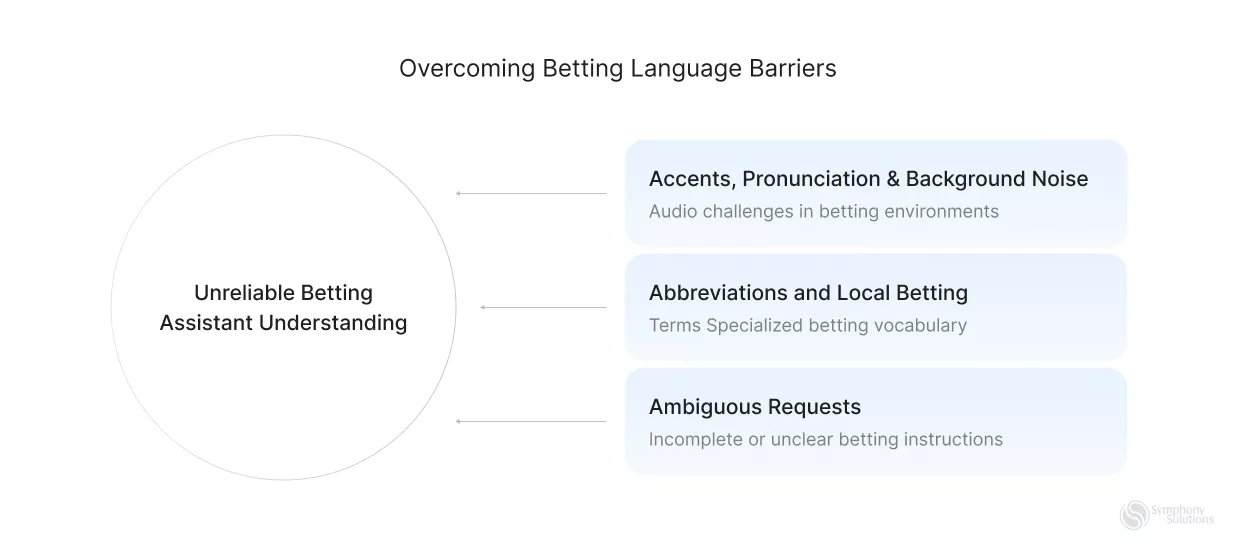
Accents, pronunciation, and background noise
The same club or player name can sound different across regions, especially when someone is speaking quickly. Stadium noise, television commentary, weak microphones, and compressed mobile audio make the task harder.
Accent variation can affect transcription accuracy too. In a peer-reviewed study of five major ASR systems, the average word error rate was 35% for Black speakers and 19% for white speakers in the study’s test corpus. The research was not about betting, but it shows why an operator cannot assume that a system will understand every player equally well. When confidence is low, the assistant should confirm the critical detail instead of guessing.
Abbreviations and local betting terms
Betting shorthand packs a lot of meaning into a few letters:
BTTS: both teams to score.
O/U: an over/under total.
ML: moneyline.
AH: Asian handicap.
Team nicknames, shortened league names, and operator-specific labels add more ambiguity. “United” is not enough to identify a fixture, while “over two” could refer to goals, cards, or corners. A domain glossary can reduce avoidable recognition errors by including clubs, competitions, players, bet types, and market aliases. For example, Google Cloud supports phrase sets and custom classes for adapting speech models to specialist terms.
Ambiguous requests need conversation
Keyword matching fails when a request is incomplete. Consider: “Put twenty on City.” Which City? Which fixture? Which currency? And which market?
A betting assistant should use the context it already has and ask only for what is missing: “Do you mean Manchester City v Chelsea? Which market would you like?” This is safer than treating a plausible guess as confirmed intent.


How BetHarmony Interprets Natural Betting Conversations
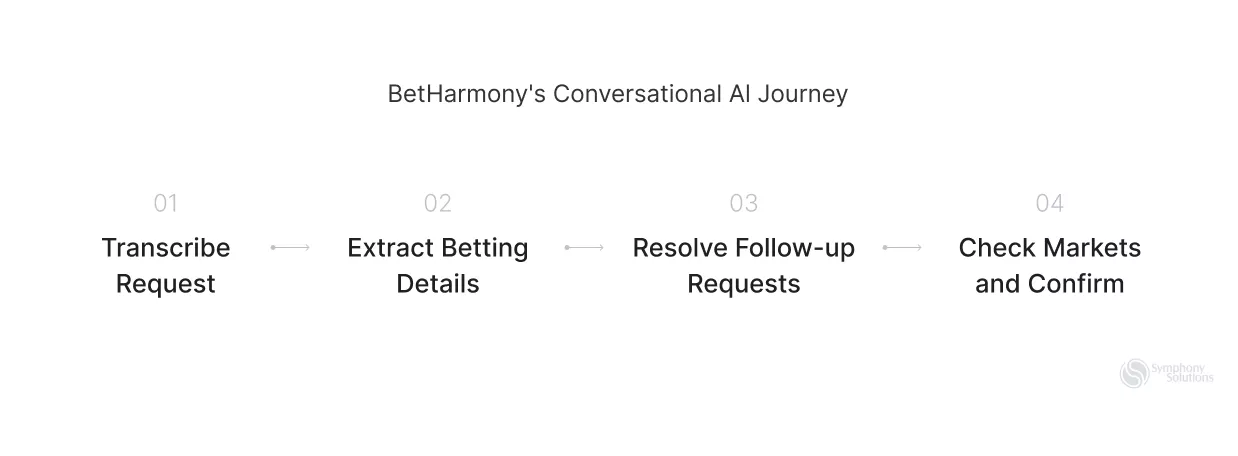
BetHarmony works as a conversational AI sportsbook layer: it combines speech recognition, NLU, context retention, and near-real-time platform integration. The BetHarmony voice AI journey can:
- Transcribe the request and recognise slang, aliases, and abbreviations.
- Extract the intended stake, event, team, market, and timing.
- Use the conversation and platform context to resolve follow-up requests.
- Check live markets and prices, then clarify or confirm before the transaction proceeds.
This approach connects voice-to-voice AI with a conversational sportsbook interface, rather than treating voice as a microphone attached to a chatbot. Operators should still govern updates and validate new terminology before it reaches players.
Business Benefits of an AI Voice Betting Assistant
For an AI sportsbook, the value of voice is not novelty. It is a shorter path between player intent and a correctly prepared action.
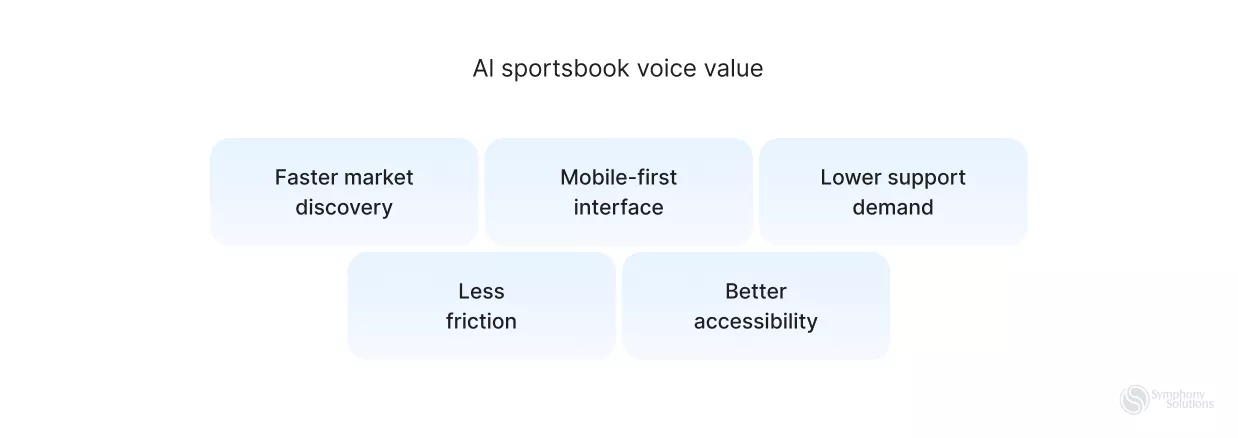
Faster market discovery: Players can ask for an event and market instead of navigating several menus.
Less friction during live betting: Context retention reduces repeated searches when seconds matter.
A mobile-first interface: Voice can reduce tapping and scrolling on small screens. Voice betting in iGaming depends on speech recognition, NLU, and real-time platform APIs working together.
Better accessibility: Speech recognition can help people who cannot use a keyboard or mouse. Voice should complement, not replace, accessible visual and touch controls.
Lower routine support demand: The same interface can answer balance, bet-history, and account-status questions before escalating complex cases.
Reliability is the condition for these benefits. Wendy’s planned to expand its AI voice-ordering system from around 100 restaurants to 500–600 US locations during 2025, while McDonald’s ended an AI drive-through pilot across more than 100 restaurants. The Wendy’s rollout and McDonald’s decision show both the opportunity and the limits of voice AI. A food order can be corrected; a bet may involve a live market and changing odds.
For operators evaluating sports betting software solutions, voice should be part of the platform, not a standalone feature. It needs current market data, secure authentication, responsible-gaming controls, and clear confirmation rules
What Operators Should Validate Before Launch
- A credible rollout needs measurable safeguards:
- Test target accents, languages, devices, and real betting phrases.
- Maintain an approved glossary of abbreviations, aliases, competitions, and local terms.
- Measure task completion and critical-entity accuracy, not only word error rate.
- Require confirmation of the event, market, stake, odds, and potential return before placement.
- Offer an immediate switch to touch, text, or human support.
The NIST AI Risk Management Framework provides a useful general structure for evaluating trustworthiness. Operators also need jurisdiction-specific legal and compliance review.


Conclusion: Voice Recognition as the Next Evolution of Sportsbook UX
Voice works best when it feels like a precise conversation. Betting AI needs accurate transcription, betting-specific language, live data, context, and restraint when a request is unclear. For a broader view of how AI agents are changing sports betting, or to plan sports betting software development, start with the platform and operational safeguards, not the microphone.
Explore BetHarmony, voice-to-voice AI, or a conversational sportsbook interface for an existing platform.
FAQ
BetHarmony says it combines speech recognition with betting-focused NLU, slang and alias recognition, and contextual interpretation. Domain adaptation is a standard way to improve recognition of specialist terms; Google Cloud and Amazon Transcribe both document vocabulary-customization methods. Exact performance should be validated against each operator’s glossary and target audience.
It can support multiple accents, but accuracy varies by model, speaker, and environment. The PNAS study on ASR disparities shows why operators should test representative speakers and monitor group-level error rates rather than rely on a single headline accuracy figure.
The typical stack includes speech-to-text, NLU for intent and entity recognition, a dialogue manager for context, real-time sportsbook APIs, and text-to-speech. IBM’s NLU explanation describes how intent and context differ from simple word matching.
It can shorten market discovery, preserve context across follow-up requests, and reduce mobile navigation. It can also improve access for some users with motor or visual barriers, although the W3C recommends understanding different user needs and tools. Operators should retain text and touch alternatives.
Operators need secure APIs for markets, odds, accounts, and bet placement; identity and consent controls; a betting-language glossary; clear confirmation rules; monitoring; and fallback channels. A staged pilot should test real accents and peak-load conditions before wider deployment, following a risk process such as the NIST AI RMF.