
Key Takeaways
- Conversational AI is shifting from scripted question-answering to an operational layer that triggers processes, moves data, and completes tasks end-to-end, changing how businesses judge AI value from fluency to follow-through. The market reflects this trajectory, projected to grow from USD 14.29 billion to USD 41.39 billion by 2030, with 23% of organizations already scaling AI agents in at least one area.
- The category is being reshaped by five converging trends: agentic task completion, multimodal and voice interfaces, deep enterprise integration, low-code platforms for rapid iteration, and human-centered governance. Deep integration into CRMs, ERPs, ticketing, and identity layers is becoming the dividing line, since agents cannot resolve issues end-to-end without real-time access to core systems.
- The hardest problems surface in production, not demos, with Gartner warning that over 40% of agentic AI projects could be canceled by end of 2027 due to cost, risk, and unclear ROI. Integration complexity, security and permissioning, and maintaining consistent context and memory are what separate real agents from basic automations mislabeled as agents.
- Winning teams treat conversational AI as a core system rather than a front-end feature, focusing on narrow high-volume workflows, embedding guardrails and approvals early, and measuring tangible outcomes like time-to-resolution and deflection rates. In regulated, high-pressure environments like iGaming, agents such as BetHarmony show the direction of travel, becoming part of the product itself rather than a separate support channel.
The future of conversational AI is being shaped beyond chatbots. What began as scripted interfaces designed to answer questions is becoming an operational layer inside modern businesses.
This shift is changing how organizations judge AI value. Fluency matters less than follow-through. The question is no longer whether an AI sounds human, but whether it can reliably act inside real workflows: trigger processes, move data, and complete tasks end-to-end.
These capabilities are driving conversational AI adoption, and the market trajectory already reflects it. According to Grand View Research, the global conversational AI market, valued at USD 14.29 billion, is on a path to reach USD 41.39 billion by 2030.
To help you understand this transition, this article examines the future of chatbots and conversational AI and outlines how organizations are deploying AI as an operational actor rather than a front-end feature.
Evolution of conversational AI: from bots to intelligent agents
The shift toward conversational intelligence did not happen by accident. It emerged from a combination of deliberate design choices and growing pressure from real-world use cases.
Early chatbots were built to handle predictable interactions. They answered FAQs, routed users through basic menus, and deflected simple requests. This worked as long as conversations stayed within narrow, predefined paths. However, once a request required context, judgment, or follow-through, those systems quickly reached their limits.
That limitation is what forced the next evolution. As conversational AI moved closer to real business workflows, answering questions was no longer enough. Systems needed to understand intent, retain context across interactions, and take action rather than hand tasks back to users.
Modern conversational AI is built around that expectation. Instead of responding to isolated messages, intelligent agents are designed to help users reach outcomes. They are built to:
- Reason over context, using conversation history, user intent, account state, and business rules to understand what the user is trying to accomplish
- Use tools, such as querying knowledge bases, accessing databases, calling APIs, and creating or updating records inside enterprise systems
- Operate across steps, planning and executing multi-step workflows rather than responding once and handing control back to the user
This shift reflects the broader move toward agent-based systems across enterprise AI. According to McKinsey, 23% of organizations are already scaling AI agents in at least one area of their operations, while 39% are actively experimenting.
The gap between basic chatbots and intelligent agents continues to widen as the underlying technology improves. The Stanford AI Index also highlights rapid gains in model performance and a steady acceleration in industry-led innovation.


What are future trends in conversational AI?
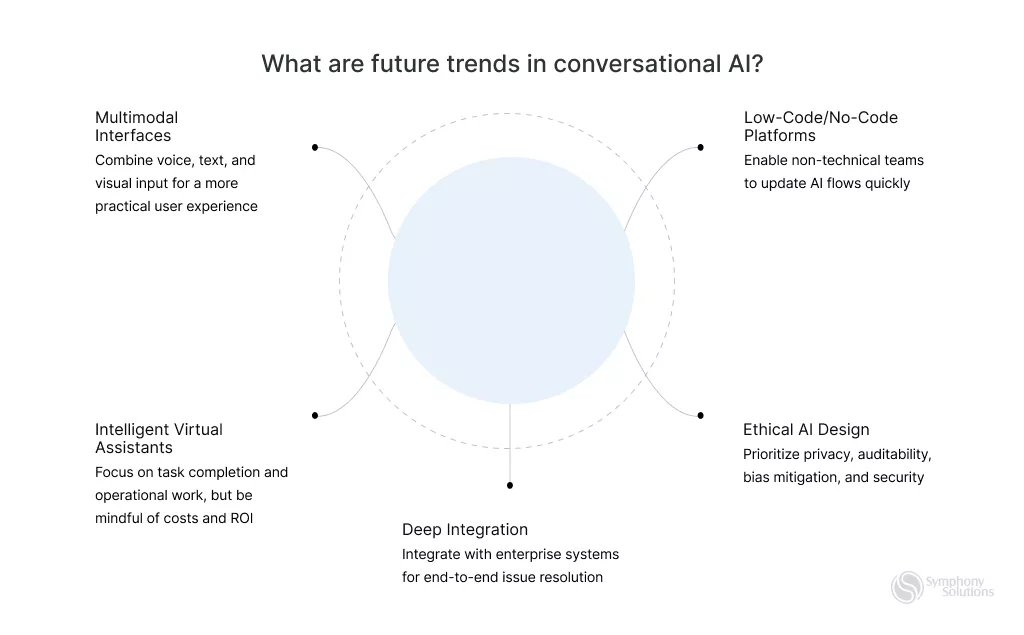
The following trends show how conversational AI is shifting from experimentation to execution in 2026.
Trend 1: Intelligent virtual assistants and agentic AI
The fastest-growing shift in conversational AI is no longer just about conversation—it’s about task completion. Modern agents are being designed to handle real operational work: triaging requests, gathering missing information, executing actions across systems, and following up seamlessly.
However, it’s important to note that this shift is not without its challenges. Gartner warns that over 40% of agentic AI projects could be canceled by the end of 2027, often due to cost concerns, risk, and unclear ROI. This happens when teams label basic automations as “agents” without the necessary data, controls, or integration.
Here’s what winning teams will do differently:
- Focus on narrow, high-volume workflows, such as support triage, onboarding, or internal operations
- Implement guardrails and approval processes early, ensuring agents operate within defined boundaries
- Measure tangible outcomes, like time-to-resolution, deflection rates, and error reduction, rather than just engagement metrics.
Trend 2: Multimodal and voice interfaces
One reason chatbots hit their limits is simple: people don’t always want to type. They talk, they share screens, they upload documents, and they expect AI to understand all of it.
That’s why conversational AI in 2026 is moving beyond text alone. Modern interfaces combine voice, text, and visual input, allowing users to speak a request, show a problem, or attach context instead of describing everything line by line.
Voice becomes useful when users are mobile or multitasking. Visual input matters when the issue lives on a screen: an error message, a betting slip, a form, or a document. Together, these modes turn conversational AI into something more practical: a guided interface that adapts to how people already work.
Trend 3: Deep integration with enterprise systems
Deep integration is becoming the dividing line for conversational AI in 2026.
As conversational AI moves from support experiments to business-critical workflows, access to enterprise systems stops being optional. Agents are increasingly expected to resolve issues end-to-end, not escalate them. Without real-time access to policies, order data, refund rules, or KYC state, conversational AI cannot meet that expectation.
That’s why future-ready deployments embed conversational AI directly into core systems, including:
- CRMs for customer and service context.
- Ticketing systems for routing and SLA enforcement.
- ERPs for orders, inventory, and billing.
- Knowledge bases for accurate, governed responses.
- Identity and permission layers to control what agents can do.
This focus on integration is why customer support is often the first area to adopt conversational AI. In fact, McKinsey highlights that while 88% of organizations say they use AI, only about 7% have fully scaled it across their entire organization. This shows that integration is the real challenge and the key to success in the future.
Trend 4: Low-code/no-code AI-powered conversational platforms
As conversational AI becomes part of everyday operations, teams need to update it quickly. Support flows change. Policies change. Prompts and logic need constant adjustment. Relying on engineering for every small update doesn’t scale.
That’s why low-code and no-code platforms are becoming central to how conversational AI is built and maintained. They allow non-technical teams (such as product, support, and operations) to adjust conversational flows themselves, without touching the underlying infrastructure.
This shift is already well underway. According to Forrester, 87% of enterprise developers use low-code platforms in some capacity. In conversational AI, this approach is increasingly applied to the interface layer, where speed and iteration matter most.
Trend 5: Human-centered and ethical AI design
Conversational AI is becoming more transactional, handling account changes, payments, identity checks, and personalized promotions. In 2026, this shift raises the bar for how these systems are designed and governed, with trust moving from a secondary concern to a core requirement.
Future-ready systems are designed with a small set of non-negotiables:
- Privacy and data minimization by default.
- Auditability, so every action can be traced and explained.
- Bias mitigation, particularly in regulated or high-impact contexts.
- Security controls for risks such as prompt injection and data leakage.
This direction is reinforced by both standards and regulations. Frameworks like the NIST AI Risk Management Framework are increasingly used as design baselines, while the EU AI Act introduces mandatory transparency requirements rolling out through 2025–2026. Together, they point to where conversational AI design is heading: accountability and clarity built in from the start.


Conversational AI in iGaming: intelligent agents redefining player interaction
iGaming exposes the limits of chatbots faster than most industries. Players expect instant help during onboarding, verification, navigation, and live play: often under time pressure and in multiple languages. In that environment, static support chat quickly falls short.
That pressure is pushing iGaming trends toward agent-based conversational AI. Instead of answering questions, iGaming conversational AI agents understand betting context, guide players through critical steps, and take action inside the product. They are part of the gameplay experience, not a separate support channel.
A practical example of this direction is BetHarmony, an AI agent. It offers 24/7 multilingual support, intuitive voice and text interactions, and proactive promotions. Integrated into platforms like BetSymphony, it illustrates how conversational AI is becoming part of the product itself, not an add-on for support.
Challenges and considerations for 2026
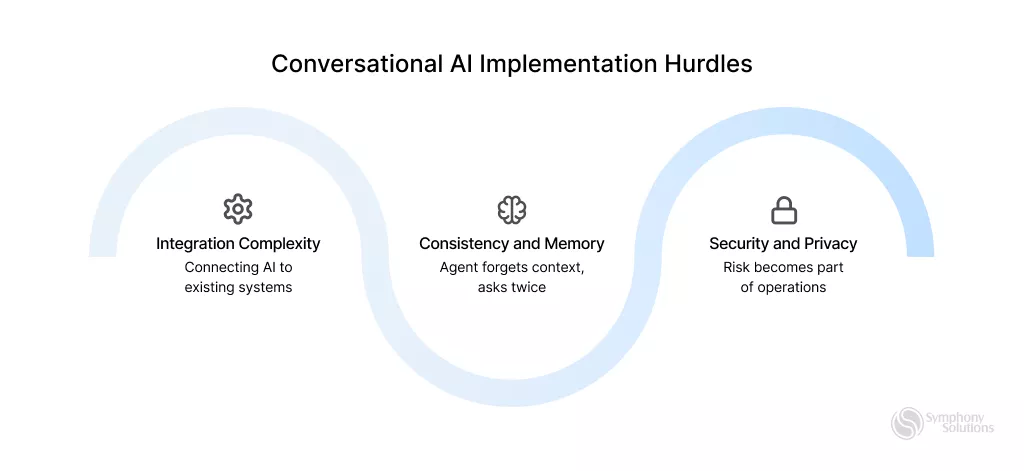
Although the conversational AI market trends show growth in 2026, a few practical issues can slow progress at the organization level if they’re not addressed. Most of them don’t show up in demos. They surface once AI systems are expected to work reliably inside real products and workflows. These include:
Integration complexity
The biggest slowdown often comes from connecting AI to existing systems. Legacy platforms, fragmented data, and outdated knowledge sources make it harder for agents to access the information they need or take action where it matters.
Security and privacy
When AI agents can trigger actions, risk becomes part of everyday operations. Clear permissions, controlled API access, and proper logging are essential from the start. These concerns quickly become real once systems are in production.
Consistency and memory
Users notice immediately when an agent forgets context, asks the same question twice, or gives conflicting answers. At scale, reliability depends less on how powerful the model is and more on how well context, retrieval, and evaluation are handled.
These challenges explain why conversational AI requires constant refinement once deployed. In complex, regulated industries like iGaming, platforms like Betharmony introduce enhancements regularly to strengthen reliability and operational control as AI moves deeper into real workflows.
Final word
In 2026, conversational AI is moving toward conversational intelligence: agent-based systems embedded into products and operations that complete tasks reliably at scale. Teams that want durable results must treat conversational AI as a core system: designed with deep integration, clear governance, and measurable outcomes from the start.
Ready to operationalize conversational AI? Explore our AI software development and consulting services.


FAQ
A chatbot typically follows scripts or narrow intents. Conversational AI combines NLP with context, retrieval, and (in modern systems) tool use—so it can understand, respond, and increasingly complete tasks inside workflows.
Intelligent interfaces are conversational layers embedded into apps and systems (text/voice/UI) that can retrieve information, guide users through steps, and trigger actions via integrations, often with guardrails and approvals.
It’s used for onboarding support, KYC guidance, payments/help flows, and account assistance: where audit trails, privacy controls, and transparency matter as much as response quality.
They’re assistants that go beyond Q&A to support player journeys end-to-end (navigation, onboarding, bet placement assistance, multilingual support), often with proactive help based on context.
The conversational AI emerging trends center on agentic systems that execute tasks, multimodal and voice interfaces, deeper enterprise integration, faster iteration through low-code tools, and built-in governance for privacy, transparency, and security