
Key Takeaways
- Sportsbook UX has barely evolved in a decade, yet over 8.4 billion voice-enabled devices are now in everyday use. The gap between how players interact with technology everywhere else and how they bet is becoming impossible for operators to ignore.
- Voice-activated betting compresses a 4 to 6 step navigation into a 3-second spoken command. In live betting, where over 50% of online wagers are placed, that difference directly affects conversion, bet abandonment, and revenue.
- The technology is not the barrier. Speech recognition, NLP, and voice biometrics are already commercially mature. The real obstacles are infrastructure: monolithic sportsbook platforms, real-time API gaps, and the absence of clear regulatory guidance for voice-based compliance flows.
- Operators who treat voice as a bolt-on feature will see limited returns. Those who use it as a forcing function to rebuild toward conversational, AI-native betting platforms, where voice, personalization, and live data work as a system, will have a structural advantage as the market matures.
Sportsbook UX has barely changed in a decade. While over 8.4 billion voice-enabled devices are now in use worldwide and people talk to phones, cars, and AI assistants daily, most betting platforms still rely on endless tapping and scrolling.
That gap is becoming harder for operators to ignore. If users are getting comfortable interacting with technology by voice everywhere else, sportsbooks need to adapt.
Voice-activated betting changes the flow completely. Instead of navigating through sub-menus to find a market, a player could simply say: “Place £10 on Liverpool to win at 2.4.” That simplicity has real implications for operators competing on engagement, speed, and accessibility, especially in live betting.
This article looks at what voice betting could realistically mean for iGaming, what is slowing adoption, and what operators may need to rethink at the platform level.
What Is Voice Activated Betting?
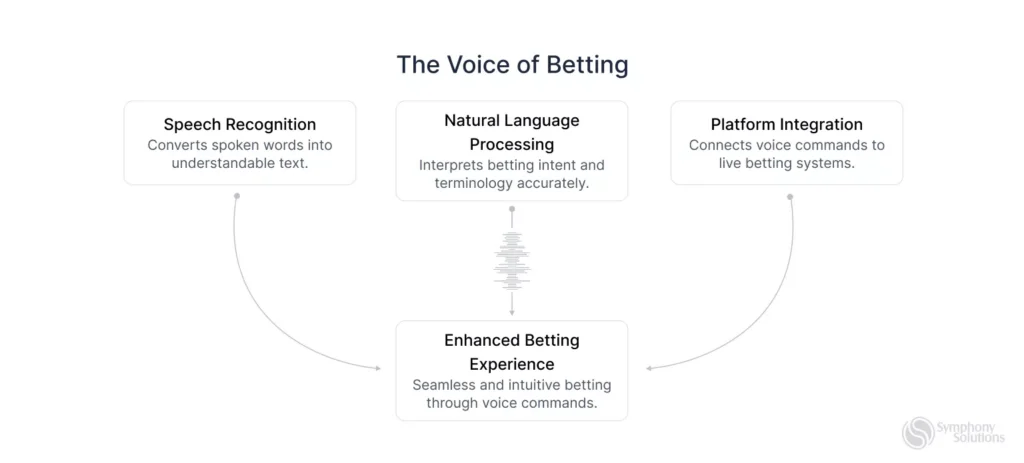
Voice activated igaming lets players interact with a sportsbook using spoken commands instead of tapping through menus. A user could ask for live odds, check account balance, request open bets, or trigger a cash-out through natural language. The technology usually combines three layers:
- Speech recognition to convert voice into text
- NLP to understand betting intent and terminology
- Platform integration to connect requests to live odds, wallets, and betting systems
Platforms like Betharmony and Voxbet are already pushing this model forward with AI-powered voice interfaces embedded into sportsbook apps. Early experiments with platforms like Amazon Alexa also suggest voice could eventually become more than just another feature layer in iGaming.


The Case for Voice Activated Betting: Benefits for Operators and Players
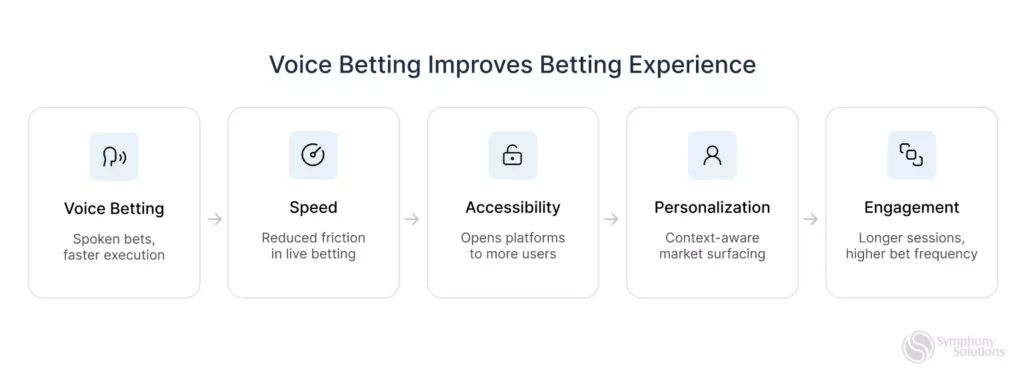
Voice interfaces solve real, measurable friction points in the current betting experience, driving value across four key areas:
1. Speed & Reduced Friction in Live Betting
In mature markets, live betting accounts for over 50% of online wagering volume. Here, speed is the product. A spoken bet takes under three seconds from intent to execution. Traditional screen navigation takes four to six times longer, leading to bet abandonment. Voice eliminates this lag, converting intent into revenue instantly.
2. Accessibility as a Growth Driver
Conversational betting opens platforms to users who struggle with traditional touchscreen navigation due to motor impairments or situational limitations (e.g., multitasking while watching a game). As regulatory expectations around accessibility tighten in licensed markets, voice tech offers a structural solution rather than a superficial fix.
3. Personalization at Scale
Conversational AI learns context. It tracks behavioral patterns—like a preference for Premier League markets, odds between 1.5 and 2.5, or Saturday afternoon live betting—and proactively surfaces relevant markets. This replicates the high-level personalization of Spotify and Amazon, which screen-based sportsbook interfaces historically fail to achieve.
4. Boosted Engagement & Retention
Lowering the cognitive load of navigation allows players to focus on the match, correlating with longer sessions and higher bet frequency. The potential for habitual adoption is massive: around 65% of smart speaker owners state they cannot imagine living without their devices.
Challenges Slowing Voice Activated Betting Adoption
Voice betting in iGaming faces a cluster of technical, regulatory, and behavioral challenges that have limited mainstream deployment so far. Let’s explore them.
1. Accuracy & Latency in Real-World Conditions
While voice tech hits 93.7% accuracy in controlled settings, real-world betting environments (pubs, stadiums) introduce heavy background noise. Furthermore, mainstream speech models struggle with niche industry jargon like “accumulator” or “Asian handicap.” In a real-money environment, even a minor recognition error results in costly transactional disputes.
2. Security, Authentication, & Fraud
Voice interfaces introduce new vulnerabilities, particularly voice spoofing (using synthesized speech to impersonate a user). While voice biometrics can authenticate users, they add latency that erodes the speed advantage of voice tech. Operators must invest in advanced liveness detection and behavioral biometrics to protect against ambient recording and replay attacks.
3. Regulatory & Responsible Gambling Compliance
Regulators like the UKGC and MGA require easy access to self-exclusion tools, deposit limits, and age verification. Voice interfaces must smoothly integrate these features without burying them in the conversational betting flow. Because explicit regulatory guidance for voice iGaming is virtually non-existent, operators face significant compliance ambiguity.
4. User Trust & Behavioral Barriers
Consumer comfort with voice technology varies wildly. Roughly 33% of US adults cite privacy concerns (specifically that devices are always listening) as a reason to avoid voice tech. This anxiety is amplified in financial transactions, meaning operators must establish bulletproof data transparency before gaining mainstream trust.


Technology Enablers Behind Voice AI Sportsbook Infrastructure
The core technology behind voice betting is already here, and it is improving fast across four main areas.
1. Speech Recognition & NLP
Models like OpenAI Whisper have pushed voice recognition accuracy much higher in recent years. The company has trained on 680,000 hours of multilingual audio, and set a new benchmark for speech recognition accuracy at scale. The NLP market is also growing quickly, from $8.49 billion in 2024 to $23.11 billion by 2030. Modern AI models can now understand complex betting requests, including bet type, selection, and stake, in near real time.
2. Real-Time Platform Integration
Voice betting only works if sportsbook data updates instantly. A player asking for live odds expects a response within seconds. That is difficult on older monolithic systems, which is why modern API-first and microservices architectures matter much more here. Platforms like BetSymphony sportsbook are now built with exactly this kind of modular architecture. They enable operators to layer new interaction modes, including voice, onto existing infrastructure without full platform replacement.
3. Context-Aware AI
More advanced voice systems can understand user context, not just commands. They can use betting history, preferences, and live match data to surface relevant markets or clarify unclear requests naturally. For operators building this capability, AI strategy consulting services provide a practical pathway from current platform architecture to a voice-ready, AI-driven stack.
4. Voice Biometrics
Voice biometrics can identify users through vocal patterns without adding extra login steps. The technology is evolving quickly alongside the wider voice assistant market, which is projected to grow from $7.35 billion in 2024 to $33.74 billion by 2030.
Where Voice Activated Betting Stands Today: Market Context
Across key iGaming markets, voice betting remains experimental. However, broader iGaming technology trends are creating the foundation for mainstream adoption:
- Massive Market Growth: The global iGaming sportsbook software market is projected to skyrocket from $86 billion to $217 billion, with mobile devices driving roughly 80% of all online wagers worldwide.
- AI Adoption Baseline: Artificial intelligence integration has already reached a 31% adoption rate among Tier 1 operators.
The operators moving fastest are not treating voice as a standalone feature. Instead, they are combining voice, chat, recommendations, and real-time notifications into broader conversational AI experiences.
Platforms like BetHarmony are already moving in that direction by combining conversational AI with sportsbook infrastructure to create more context-aware and natural betting experiences.
Bottom line
Voice betting is still early in iGaming, but the technology and user behavior are already there. Around 157.1 million people in the US use voice assistants, and the industry’s mobile-first nature makes sportsbooks a strong fit for conversational interaction.
The bigger challenge is infrastructure. Voice betting depends on real-time APIs, AI personalization, voice biometrics, and compliance systems that many older sportsbook platforms were never built for.
The operators moving early will have a major advantage. But the sportsbooks that succeed here will treat voice as more than just another feature. It will require a completely different approach to the betting experience itself.


FAQ
Voice betting lets players place bets, check balances, ask for odds, or cash out using spoken commands. It combines speech recognition, NLP, and real-time sportsbook integration to process requests naturally.
The main challenges are speech accuracy in noisy environments, understanding betting terminology, reducing latency during live betting, user authentication, and handling compliance requirements inside conversational flows.
It can be, if the platform uses strong security layers like voice biometrics, liveness detection, and real-time authentication systems.
AI voice betting removes a lot of manual navigation. During live betting, players can react faster without constantly searching through menus, while AI can surface more relevant markets and betting suggestions in real time.
Most operators need real-time APIs, microservices architecture, conversational AI layers, voice authentication tools, and compliance systems that work inside voice-based interactions.